Get in Touch


    Contact Us

    admin

    CyberSecurity

    Security Doesn’t End After Login : How modern cyber attacks bypass even strong authentication

    In the world of enterprise cybersecurity, we are obsessed with the front door. Organizations invest heavily in two-factor authentication (2FA), multi-factor authentication (MFA), hardware keys, and conditional access policies. Login screens look fortified. Compliance checklists are checked. Confidence is high.We look at our fortified login screens and pat ourselves on the back because the perimeter is secure. But attackers aren’t trying to break down the front door anymore. They are sliding through the open window. In 2025, the identity perimeter has shifted. It is no longer about Credentials (username and password); it is about Sessions (tokens and cookies). If an attacker steals a session token, your MFA is irrelevant. They don’t need to log in; they are already you. The Mechanics: Hotel Keys and Valet Drivers   To understand the threat, we first need to understand the keys we are actually protecting. It’s not just your password anymore. 1. The “Hotel Key Card” (Session Cookies) When you log into Gmail, Slack, or Microsoft 365, you do not re-enter your password for every action. After authentication, the system issues a session cookie, stored in your browser. This cookie acts like a hotel key card: It proves you already logged in It unlocks resources automatically It does not trigger 2FA again If a session cookie is stolen through malware, malicious browser extensions, or endpoint compromise, the attacker inherits the session completely.  No password. No MFA. No warning. 2. The “Valet Key” (OAuth Tokens) OAuth powers features like Sign in with Google, Sign in with Microsoft, and third-party app integrations. Instead of sharing passwords, OAuth issues access tokens that allow apps to act on a user’s behalf. These tokens often: Persist for long periods Are not tied to device integrity Are not re-challenged by MFA OAuth tokens are convenient by design. They are also powerful by nature. Attackers do not steal passwords anymore. They steal tokens. Like When you connect a third-party app (like a calendar scheduler) to your corporate email, you are using OAuth. You give that app a “Valet Key”- a limited token that lets it park your car (read your calendar) without giving it your main car keys (your password). The danger? Attackers are stealing the Key Cards and Valet Keys. Where Two-Factor Authentication (2FA) Fits and Where It Fails   Two-factor authentication is an essential control. It prevents simple credential theft and blocks many automated attacks. However, 2FA only protects the login event. Once authentication succeeds: Session cookies are issued OAuth tokens are minted Trust is assumed to persist If an attacker steals a valid session or token, they do not trigger 2FA again. The system assumes authentication already happened. This is why many breaches occur after login, not during it. 2FA is necessary. But it is not sufficient on its own. The Attack: Token Theft & Shadow Integrations   “Pass-the-Hash” is dead. Long live “Pass-the-Cookie.” In a Token Replay attack, a hacker doesn’t need to guess your password. They simply deploy malware (often via a simple phishing link) to scrape your browser’s local storage. They steal the “Hotel Key Card” (the active session cookie) and import it into their own browser. The result is terrifyingly simple: No Password Required: The attacker is now logged in as you. No MFA Prompt: The system sees a valid cookie and assumes MFA was already passed. SaaS-to-SaaS Lateral Movement: Once inside, they use OAuth to install malicious apps (“Shadow Integrations”). They might grant a rogue application permission to “Read All Files” on your Google Drive. Even if you change your password later, that rogue app still holds the Valet Key. It stays connected, silently siphoning data. When the Front Door Fails: The “MFA Fatigue” Nightmare   Even when attackers do try the front door, they have found a psychological loophole to bypass the technology. This is called MFA Fatigue (or “MFA Bombing”), and it specifically targets push-notification systems like Duo Push or other common systems The tactic is brutal in its simplicity. The attacker, holding your compromised username and password, triggers a login request. You get a notification on your phone: “Login Request: Approve?” You deny it. They send another. And another. And another. At 3:00 AM, frustrated, half-asleep, or confused, the user finally hits “Approve” just to make the phone stop buzzing. Game over. The attacker is in. Other Common MFA Abuse Examples Microsoft Authenticator and Okta Verify Both rely on push approvals by default. Without number matching, attackers can overwhelm users with requests until one is approved. SMS-based OTP Attackers use SIM swapping or social engineering to intercept one-time passcodes. Once the code is entered, access is granted. Email-based OTP If an email inbox is already compromised, OTP emails offer no protection at all.  In all cases, the weakness is the same. Authentication trusts user intent, not user certainty. Real-World Case Study: The Uber Hack (Lapsus$)   This isn’t theoretical. In September 2022, the hacking group Lapsus$ breached Uber using exactly these techniques, proving that a multimillion-dollar security budget can be defeated by a $10 dark web purchase. The Timeline of the Breach: The Entry: Attackers purchased a contractor’s stolen credentials on the dark web. The Block: They attempted to log in but were stopped by MFA. The Bypass: They spammed the contractor with Duo Push requests for over an hour. The Social Engineering: The attacker contacted the contractor on WhatsApp, pretending to be “IT Support,” claiming the notifications would stop if they just accepted one. The Fallout: The contractor hit “Approve.” Lapsus$ gained VPN access, scanned the intranet for secrets, found hardcoded admin credentials, and took over the company’s AWS, Google Cloud, and Slack instances. The GiSax Perspective: Identity Is a Continuous System   At gisax.io, identity is treated as infrastructure, not a feature. Modern environments are shaped by: OAuth tokens session cookies non-human identities automation and AI agents The real challenge is ensuring that trust does not persist when context changes. Secure systems must: Continuously evaluate session legitimacy Detect abnormal token behavior Surface shadow integrations Re-challenge identity
    Uncategorized

    Gisax Leads AI-Driven Software Development in South Africa 2026

    The technology landscape in South Africa is rapidly evolving, and 2026 is set to be a transformative year for businesses leveraging artificial intelligence. At the forefront of this change is Gisax, a pioneer in AI-driven software development. Known globally for its innovative approach, Gisax empowers organizations to enhance operations, improve efficiency, and deliver cutting-edge digital solutions. With the growing demand for intelligent systems, South African companies now have a reliable partner in Gisax to implement AI-driven software solutions that transform their businesses. Gisax is not just any technology provider; it is a visionary AI software development company that integrates intelligence at the core of its offerings. Traditional software development often lacks adaptability, but Gisax ensures that AI-powered software is embedded from the start, making solutions predictive, automated, and highly efficient. This focus on AI-driven software development allows businesses to make faster, data-driven decisions, optimize workflows, and deliver superior customer experiences. Transforming South African Businesses with AI-Driven Software Solutions In a competitive market like South Africa, companies require sophisticated tools to stay ahead. Gisax’s AI-driven software solutions address these challenges by automating complex processes, improving decision-making, and generating actionable insights. Financial institutions, healthcare providers, and enterprises across sectors are increasingly adopting AI software development from Gisax to modernize operations and launch scalable digital platforms. The strength of Gisax lies in its holistic approach to AI-driven software development. By following a structured concept-to-code methodology, ideas are transformed into production-ready software efficiently and accurately. This approach enables South African businesses to implement AI-powered software quickly, adapt to market changes, and achieve measurable results. Custom AI-Driven Software Development for Every Industry Gisax recognizes that every business has unique needs. That’s why its AI-driven software solutions are fully customizable. Whether automating high-volume tasks, integrating real-time analytics, or building customer-facing applications, Gisax creates software aligned with specific organizational requirements. By combining advanced AI technologies with deep industry knowledge, the company delivers AI software development that is both intelligent and practical. Beyond development, Gisax provides end-to-end support, including mobile app creation, cloud integration, and IT staff augmentation. These services ensure that businesses can scale rapidly and efficiently while benefiting from AI-powered software designed for long-term success. Driving Growth with AI-Powered Software and Predictive Systems A key advantage of working with Gisax is the integration of predictive intelligence within software solutions. These AI-driven software solutions help organizations anticipate trends, reduce risks, and optimize performance. For example, predictive analytics can reveal customer behavior patterns, operational inefficiencies, or market opportunities, enabling proactive decision-making. Gisax’s AI-powered software goes beyond functionality; it evolves with the business. By embedding AI into the architectural foundation, systems learn and improve over time. This ensures sustainable growth, making it easier for South African companies to stay competitive in a rapidly advancing technological landscape. Why Choose Gisax as Your AI Software Development Company Gisax distinguishes itself as a leading AI software development company through several factors. Its team of experts brings together diverse skills in AI, software engineering, and IT consulting, allowing complex challenges to be addressed with precision. Its global presence and local insights ensure solutions are technically advanced and contextually relevant for South African businesses. By choosing Gisax, organizations gain a strategic technology partner rather than just a vendor. This collaborative approach fosters innovation, accelerates adoption of AI-driven software solutions, and ensures measurable results for companies leveraging AI-powered software. The Future of AI Software Development in South Africa 2026 As 2026 unfolds, AI-driven innovation will play a critical role in shaping South African businesses. Companies adopting AI-driven software development will experience enhanced efficiency, smarter decision-making, and improved customer engagement. With Gisax’s AI-driven software solutions and AI-powered software, South African enterprises are well-positioned to lead in their industries. From enterprise-grade applications to scalable IT staffing solutions, Gisax continues to redefine what it means to be an AI software development company. By embedding intelligence at the heart of software, Gisax ensures that businesses are ready for the future of technology.

    CyberSecurity

    The Future of Cybersecurity Starts With How We Think About Trust

    What individuals and organizations need to rethink to stay secure in an AI-driven world 1. Cybersecurity Has Quietly Changed Shape Just a few years ago, cybersecurity felt like a defined set of tools. Stronger passwords. Better firewalls. More alerts. It was treated as a technical discipline, isolated within IT teams, designed to keep bad actors out of safe systems. That world no longer exists. Today, cybersecurity is the underlying fabric of how we work, communicate, and build. We operate in ecosystems powered by cloud computing, remote access, SaaS platforms, and AI-driven automation. The traditional boundary between inside and outside has dissolved. We are no longer protecting a single perimeter. We are managing thousands of identities, sessions, devices, and integrations every second. The question is no longer whether defenses are strong enough. It is whether systems are resilient enough to function in a world where the perimeter exists everywhere. 2. The New Reality: Trust Is the Real Attack Surface Modern security failures rarely begin with broken encryption. They begin with misplaced trust. For decades, systems were built around a simple assumption: authenticate once, then trust continuously. In modern environments, that assumption no longer holds. We trust that: A logged-in user is still legitimate hours later A connected application will behave as expected A verified device remains uncompromised An approved session should persist indefinitely Attackers exploit these assumptions. They do not break in. They wait for trust to outlive its context. This is why modern identity-based attacks succeed. The future of cybersecurity is not about stronger gates. It is about validating trust continuously. 3. How AI Changed the Economics of Cyber Attacks Artificial Intelligence did not invent cyber risk. It changed the economics of cyber attacks. What once required skilled attackers now requires automation. AI enables: Scale: Millions of attempts with minimal effort Speed: Exploits faster than patch cycles Precision: Highly convincing messages and impersonation Attackers today are not lone hackers. They are efficiency-driven operators optimizing for return on effort. Defensive systems must respond by increasing friction, detecting abnormal behavior, and limiting long-lived trust. 4. What This Means for Individuals Cybersecurity is no longer something individuals can fully outsource to technology. Security today is shaped by everyday behavior: Reviewing app permissions before clicking “Allow” Being cautious with login approvals and notifications Understanding that convenience often expands risk Treating digital identity as something valuable You do not need technical expertise to reduce risk. You need awareness. Your digital identity is now one of your most important assets. 5. What This Means for Organizations Organizations rarely fail because of one breach. They fail because of accumulated assumptions. Temporary access becomes permanent. Old integrations remain active. Complexity grows faster than visibility. Modern organizations must prioritize: Visibility over control Simplicity over complexity Resilience over perfection Secure systems are not those that never fail. They are those that detect early, limit damage, and recover quickly. 6. Looking Ahead: Harvest Now, Decrypt Later Cybersecurity timelines are expanding. Sensitive data stolen today may not be usable immediately. Instead, attackers increasingly follow a harvest now, decrypt later approach, storing encrypted data until future advances in AI or quantum computing make decryption possible. This shifts the focus from short-term protection to data longevity. Organizations must ask: How long will this data remain sensitive? Future-ready security depends on crypto agility, the ability to adapt cryptographic standards without disrupting systems. 7. What Needs to Change Now The next phase of cybersecurity requires a mindset shift. From static trust to dynamic trust From prevention-only to adaptive systems From security as a function to security as architecture  Access should expire. Assumptions should be questioned. Systems should be designed to evolve. Security that cannot change will eventually fail. 8. The GiSax Perspective: Security as System Design At gisax.io, cybersecurity is treated as a design principle, not a bolt-on layer. Modern systems are built on: Identities rather than locations Sessions rather than logins Integrations rather than isolated tools Automation rather than manual processes In this environment, security must be: Context-aware Continuously evaluated Architected into systems from the start Resilient systems are designed with change in mind. That philosophy shapes how future-ready platforms are built. 9. Conclusion The future of cybersecurity will not be decided by tools or budgets. It will be decided by how we design trust. Cybersecurity today is shared between individuals, organizations, and the systems that connect them. Security outcomes depend on awareness, architecture, and behavior working together. By shifting focus from defending perimeters to managing trust, we can build a digital future that is not only connected, but genuinely secure. Frequently Asked Questions (FAQs) 1. What is cybersecurity? Cybersecurity is the practice of protecting computers, networks, and data from attacks or unauthorized access. 2. Why is cybersecurity important? It keeps your personal information, money, and digital accounts safe from hackers. 3. What is a cyber attack? A cyber attack is when someone tries to steal, damage, or misuse digital information. 4. What is phishing? Phishing is when attackers pretend to be a trusted company or person to trick you into sharing sensitive information. 5. What is malware? Malware is harmful software designed to damage devices, steal data, or take control of systems. 6. What is two factor authentication (2FA)? 2FA adds an extra security step, like a code sent to your phone, to confirm it is really you logging in. 7. How can I stay safe online? Use strong passwords, enable 2FA, avoid suspicious links, and keep your apps updated. 8. What is data encryption? Encryption protects information by converting it into a secret code that only the right person can read. 9. What is ransomware? Ransomware is malware that locks your files until you pay money to the attacker. 10. What should a company do to protect itself? Use secure systems, update software regularly, train employees, and monitor for unusual activity. 11. What is synthetic identity fraud?  It is fraud where attackers create a fake person using AI-generated biometrics and stolen data. 12. What is a deepfake injection attack? It is an

    Data & Systems

    How Data Moves Through a Modern Organization

    From databases to decisions, data is constantly in motion inside modern businesses. Data does not sit still in modern organizations. It moves continuously across applications, databases, data pipelines, analytics platforms, and business systems. What begins as a single user interaction or transaction often passes through multiple layers of infrastructure before it reaches a dashboard, a report, or a decision-maker. Along the way, the same piece of business data may be transformed, enriched, aggregated, or combined with other sources. Each transformation changes how the data can be used and who can use it. This is why understanding data flow is not just about visibility, but about control and intent. Many challenges associated with data analytics, AI adoption, or enterprise security do not start at the reporting layer. They begin much earlier in how data is generated, stored, structured, and shared across the organization. Understanding how data moves through a modern organization is the foundation for building reliable analytics, scalable systems, and consistent decision-making. Where Data Is Created Every organization today is a data-generating system. Customer interactions, internal workflows, operational processes, and system events continuously create raw business data. Some of this data is obvious, such as purchases, sign-ups, or payments. Other data is generated quietly through logs, background services, integrations, and operational tooling. What makes this complex is volume, velocity, and variety. Data is created constantly, often in real time, and from multiple sources at once. For example, At Amazon, a single customer order generates multiple layers of data: transactional data for billing and payments operational data for inventory and fulfillment behavioral data for recommendations and personalization financial data for accounting and reporting The key takeaway is that data is rarely created for a single purpose. Its value emerges when it can move across systems and support multiple functions without losing accuracy or context. Where Data Lives and Why It Fragments Once data is created, it needs a source of truth. Databases, data warehouses, and systems of record store transactional and historical data that other systems depend on. Together, they form the backbone of enterprise data management. In reality, most organizations do not operate with a single database. Data is distributed across: operational databases for live transactions internal tools supporting team workflows analytics systems used for reporting and business intelligence This distributed data architecture enables scale and flexibility. However, without clear data ownership, governance, and consistency, fragmentation increases. Teams maintain different versions of the same data, definitions drift, and reconciliation becomes a recurring effort. When fragmentation grows, analytics loses credibility and decision-making slows down, even though more data is technically available. Different Types of Data Serve Different Decisions Not all data is meant to be used in the same way. Some data exists to support real-time operations. Some supports trend analysis. Some exists purely for compliance or auditing. Problems arise when these distinctions are ignored. For instance, A ride booked on Uber produces data that supports: real-time pricing and routing decisions operational efficiency for drivers and support teams aggregated analytics for city-level planning and expansion Transactional data, operational data, and analytical data may originate from the same event, but they exist to answer different questions. Treating all data as interchangeable often results in systems that inform but do not decide. How Data Moves Across Teams As organizations grow, data movement becomes horizontal as much as vertical. Data no longer flows only from systems to leadership. It moves across teams, functions, and tools, often simultaneously. In large retailers like Walmart, inventory data flows from physical stores to central platforms and then to supply chain systems, finance teams, and leadership dashboards. Each team consumes the same underlying data differently based on their responsibilities, timelines, and risk tolerance. The challenge is not access to data. It is alignment. When data reaches the right team too late, in the wrong format, or without context, it becomes informational rather than actionable. Where Data Pipelines Break Down As data moves through multiple systems, friction is inevitable. Data pipelines ingest, transform, and distribute data. Over time, as systems grow, pipelines become complex. New sources are added. Temporary fixes accumulate. Parallel pipelines emerge. Common breakdowns include: data silos where teams maintain separate versions of the same dataset metric duplication leading to conflicting numbers data latency where insights arrive too late to influence outcomes By the time data reaches dashboards or analytics tools, it may already be disconnected from operational reality. This is often where trust in data begins to erode. GiSax Perspective At gisax.io, we often see data challenges appear at the analytics or reporting layer, but originate earlier in how data flows through an organization. Data is created across multiple systems, passed through integrations, and reused by different teams, often without consistent structure. In practice, this usually shows up as: data duplication as information moves between tools delays as data passes through multiple systems the same data being interpreted differently by different teams As organizations grow, data flows tend to evolve organically. New tools are added, integrations are built incrementally, and dependencies increase. Over time, this makes it harder to maintain consistency and trust. From our experience, understanding how data moves end to end helps bring clarity. When data flow is predictable, everything built on top of it becomes easier to manage. When it isn’t, even basic reporting can become difficult to rely on. Conclusion: Why Understanding Data Flow Is Strategic Before investing in advanced analytics, AI-driven systems, or automation, organizations need clarity on how data actually moves through their infrastructure. Data flow is not just a technical concern. It is an organizational and strategic one. When data flows are designed with intent, analytics becomes reliable, decisions become faster, and systems scale without losing trust. Understanding how data moves through a modern organization is the baseline requirement for everything that comes next. FAQs 1. What is data flow in an organization? Data flow refers to how data is created, stored, processed, and shared across systems and teams. 2. What is data analytics in simple terms? Data analytics

    Data & Systems

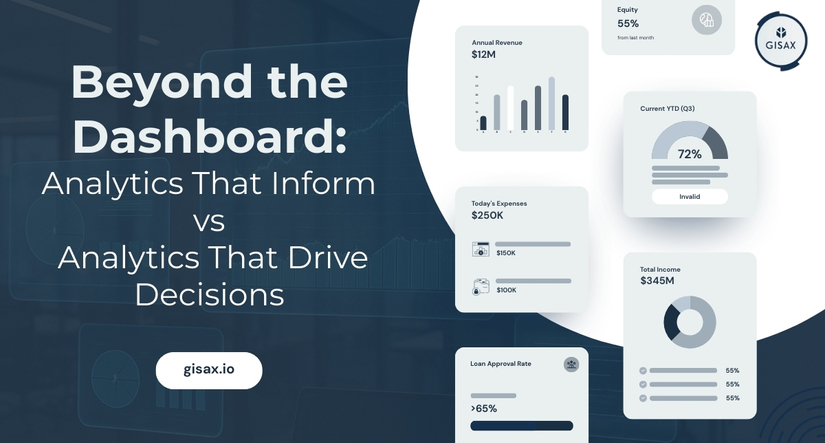
    Beyond the Dashboard: Analytics That Inform vs Analytics That Drive Decisions

    Dashboards are everywhere. Decisions are not. Most modern organizations have invested heavily in analytics dashboards. Business intelligence tools, internal reporting systems, and real-time monitoring views are now standard across teams. Dashboards are everywhere. Decisions are not. Most modern organizations have invested heavily in analytics dashboards. Business intelligence tools, internal reporting systems, and real-time monitoring views are now standard across teams. Metrics update automatically, charts refresh live, and KPIs are always visible. Yet despite this maturity, many dashboards still fail to influence decisions in a meaningful way. The issue is rarely tooling. It lies in how dashboards are designed, what data feeds them, and whether the logic behind the dashboard is built for visibility or for execution. What Actually Goes Into an Analytics Dashboard A dashboard may look simple on the surface, but technically it sits at the very end of a long data pipeline. Behind every analytics dashboard is a layered system that includes data ingestion, transformation, aggregation, and business logic. Dashboards do not generate insights on their own. They surface the output of decisions already made during system design. At a foundational level, dashboards are typically built on: data sources such as transactional databases, logs, APIs, and third-party platforms data pipelines that extract, clean, transform, and load data into analytical stores metrics and KPIs defined through business logic and calculation rules aggregation layers that convert raw data into usable signals visual components such as charts, tables, filters, and drill-downs Most dashboards are engineered to ensure accuracy and completeness, not decision speed. As a result, they are excellent at explaining what happened, but limited in shaping what happens next. Analytics That Inform: Reporting-First Dashboards Informational dashboards are designed to answer retrospective questions. From a technical standpoint, these dashboards are optimized for stability and consistency. They usually rely on batch data processing, scheduled refresh cycles, and predefined KPIs that are reviewed at fixed intervals. Because of this design, informational dashboards are best suited for: performance reviews leadership updates audits and compliance reporting historical trend analysis However, these dashboards rarely contain decision logic. The system presents the data, but the responsibility of interpretation, prioritization, and action is pushed entirely onto the user. This human dependency introduces delay and inconsistency. The dashboard informs, but it does not act. Analytics That Drive Decisions: Execution-Oriented Dashboards Decision-driven dashboards are built with a fundamentally different objective. Instead of focusing only on visualization, they encode decision intelligence into the analytics layer itself. This shifts dashboards from being passive reporting tools to active components of execution. Technically, decision-driven dashboards tend to include: thresholds and rules that define when intervention is required event-based triggers instead of only time-based refreshes prioritization logic that highlights what matters now role-specific views aligned to how different teams operate integration with workflows such as alerts, tickets, or automated actions Rather than asking users to scan dozens of metrics, these dashboards surface only what requires attention. The system reduces ambiguity before a human ever sees the data. Why Most Dashboards Stop at Visualization Most dashboards stop at visualization because the underlying analytics architecture is designed for reporting, not execution. Common technical limitations include: metrics defined without decision context dashboards disconnected from operational systems lack of real-time or event-driven pipelines no alerting or escalation logic analytics isolated from action workflows When these limitations exist, dashboards become passive by design. Teams must constantly monitor, interpret, and decide what to do next. At scale, this approach breaks down. Context Is a Data Modelling Problem Context is often treated as a UX issue. In practice, it is a data modelling and system design problem. Context is determined by: how metrics are defined which dimensions are included or excluded how data is segmented by role, geography, or time how anomalies and deviations are detected When dashboards lack context, it is usually because the data model was designed to summarize information, not to support decisions. Decision-driven dashboards require tighter coupling between data models, business logic, and operational outcomes. Real-World Case Study: How Netflix Uses Analytics to Drive Decisions A strong example of decision-driven analytics at scale can be seen at Netflix. Netflix does not treat dashboards as reporting tools alone. Analytics is deeply embedded into how decisions are made across content, product, and operations. Viewing data, engagement metrics, and experimentation results flow through systems that directly influence content investments, recommendations, and platform changes. Dashboards at Netflix are designed to answer specific decision questions: which content should be promoted or deprioritized which experiments should be scaled or rolled back where engagement signals indicate risk or opportunity Instead of reviewing static reports, teams interact with analytics that is contextual, role-specific, and tied to execution paths. This is what allows analytics to move beyond visibility and consistently shape outcomes. Designing Dashboards for Decision Velocity From a technical perspective, dashboards that drive decisions share a few common characteristics. They typically favor: fewer metrics with higher signal quality real-time or near-real-time data pipelines embedded alerts and triggers clear ownership and routing tight integration with downstream systems These systems prioritize decision velocity over data completeness. The goal is not to show everything, but to surface what matters when it matters. The GiSax Perspective At gisax.io, we see dashboards as interfaces for understanding complex systems, not just as reporting layers. The way dashboards are designed depends heavily on how data is processed, structured, and contextualized before it reaches the visual layer. This approach is reflected in the Digital Data Processing and Prediction (D2P2) system built for a data-heavy environment where digital signals were fragmented across platforms. D2P2 is a real-time social media tracing and sentiment analysis system designed to monitor digital engagement, public opinion, sentiment, and online narratives across platforms such as Facebook, Instagram, Twitter (X), YouTube, Google News, and others. By consolidating these signals, the system reduced manual monitoring, delayed insights, and reliance on static third-party reports. Experiences like this shape how we think about dashboards – not as static summaries, but as tools that surface timely signals, patterns, and context. That perspective drives how we

      book a visit to India