
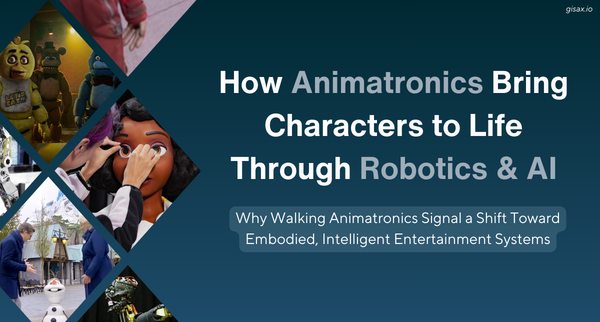
The End of the Bolted Era: How Autonomous Animatronics Are Redefining Theme Parks
Why Walking Animatronics Signal a Shift Toward Embodied, Intelligent Entertainment Systems The Backstory: The Evolution of Audio-Animatronics For more than six decades, the word animatronic meant something very specific. A figure anchored to the floor. Driven by hydraulics or pneumatics. Executing a perfectly timed, endlessly repeating loop. From the Enchanted Tiki Room in 1963 to the unnervingly fluid Shaman of Songs in Pandora – The World of Avatar, the craftsmanship was extraordinary. But the constraint was absolute. These machines could perform, but they could not adapt. They could impress, but they could not exist beyond their marks. That era is ending. Theme parks are no longer building mechanical figures. They are building robotic actors. The shift from loud, pressure-driven hydraulics to thousands of silent electric servomotors has unlocked something new. Motion that feels intentional. Micro-expressions. Weight shifts. Hesitation. Recovery. Movements that resemble decision-making rather than playback. The tether is gone. From Scripted Motion to Autonomous Agency Traditional animatronics were closed systems. Every movement was pre-authored. Every interaction predetermined. Modern animatronics are open, autonomous systems. They perceive their environment. They adjust balance in real time. They respond to unpredictable human behavior. This shift has been driven largely by the research divisions of Disney Imagineering and Universal Creative, where robotics, control theory, and machine learning now sit at the core of themed entertainment design. The language has moved beyond show control. The new focus is autonomous agency. Why Walking Changes Everything Teaching a robot to walk in a controlled lab is manageable. Teaching it to walk among guests, across uneven terrain, in heat, rain, noise, and crowds, is an entirely different problem. Once animatronics leave the floor, scripted animation collapses. Every step becomes a real-time physics challenge involving balance, momentum, and recovery. That is why modern systems rely on reinforcement learning. Instead of programming joint angles, engineers define intent: maintain balance recover when bumped move playfully or cautiously remain in character under disruption Robots train across millions of simulated environments, learning stable, adaptive gaits that hold up in the real world. Movement is no longer replayed. It is continuously generated. The Infrastructure Behind Modern Animatronics Compliance Technology and Electric Actuation One of the biggest historical challenges in walking animatronics was vibration. Fast motion caused entire structures to shake, forcing designers to slow everything down and sacrifice realism. Disney Imagineering solved this with compliance technology. Compliance allows joints to absorb kinetic energy, similar to shock absorbers or biological tissue. Instead of rigid stops, motion is dampened and stabilized in real time. Paired with fully electric servomotors, this enables: smoother motion higher precision silent operation longer operational cycles Hydraulics are steadily disappearing from next-generation animatronics. Case Study: Olaf at Disneyland Paris Beginning in 2026, Disneyland Paris is set to debut a free-roaming Olaf in the World of Frozen. This is not a costumed performer. Olaf is designed as a walking robotic character, capable of: navigating open guest areas maintaining balance autonomously engaging in high-frequency verbal interaction emoting while in motion Under the hood, this requires whole-body motion planning, inertial measurement units, real-time control loops, and natural language processing layered on top of locomotion. Olaf does not perform at guests. He exists with them. Small Characters, Serious Robotics: Project Kiwi One of the hardest problems in themed robotics is small-scale bipedal motion. Characters like Baby Groot are too small for human performers and intentionally proportioned in mechanically unstable ways. Disney’s Project Kiwi addressed this by creating a compact platform that integrates: lightweight skeletal structures internal cooling channels quasi-direct-drive actuators high-frequency inertial feedback Artists define how the character should feel. The control system manages the physics invisibly. This is where creative intent drives engineering, not the other way around. Universal Studios and Visceral Robotics While Disney prioritizes emotive believability, Universal Studios leans into physical intensity and scale. In attractions like Monsters Unchained, Universal deploys massive animatronics capable of fast, aggressive movement. High-torque actuation creates momentum and presence that feels tangible. Guests do not just see the character. They feel it. Different philosophies. Same destination. Perception Is Now Part of the Performance Modern animatronics rely on sensor fusion: computer vision LiDAR for proximity detection inertial sensing for balance environmental awareness Characters decide when to engage, pause, or disengage based on guest behavior. Performances become situational rather than repetitive. The show is no longer fixed. It emerges. What This Shift Really Signals This evolution is bigger than theme parks. Parks are becoming test environments for embodied intelligence, where robots learn how to: share space with humans move without startling interact without threatening exist without demanding attention Entertainment is simply the safest place to begin. Final Thought Animatronics once relied on illusion. Today, they rely on intelligence in motion. As machines learn to balance, perceive, and respond in real space, the question is no longer whether they can perform, but whether they can belong. The bolted era is over. Frequently Asked Questions What are autonomous animatronics ? Robotic characters that perceive their environment, maintain balance, and interact dynamically without fixed motion scripts. Why was Pandora a turning point for animatronics? It demonstrated the emotional ceiling of stationary systems and revealed the need for mobility. How is reinforcement learning used in animatronics? Robots learn stable, adaptive motion through simulation rather than manual animation. Are these robots fully autonomous? Most operate in hybrid mode with onboard intelligence and remote safety oversight. How do walking animatronics stay balanced? Through inertial sensors, real-time control loops, and compliance technology. Are free-roaming animatronics safe around guests? Yes. They use dynamic safety zones and behavior-based responses rather than abrupt stops. Why not use human performers instead? Robotics enables characters that are too small, too large, or physically impossible for humans. Will animatronics replace cast members? No. Robotics expands what characters can exist; humans remain essential. Why are theme parks ideal robotics testbeds? They provide real crowds, emotional feedback, and controlled chaos. Is animatronics technology used beyond theme parks? Yes. Similar systems are being explored for service robots and public-space interaction.