Get in Touch


    Contact Us

    Data & Systems

    Data & Systems

    How Data Moves Through a Modern Organization

    From databases to decisions, data is constantly in motion inside modern businesses. Data does not sit still in modern organizations. It moves continuously across applications, databases, data pipelines, analytics platforms, and business systems. What begins as a single user interaction or transaction often passes through multiple layers of infrastructure before it reaches a dashboard, a report, or a decision-maker. Along the way, the same piece of business data may be transformed, enriched, aggregated, or combined with other sources. Each transformation changes how the data can be used and who can use it. This is why understanding data flow is not just about visibility, but about control and intent. Many challenges associated with data analytics, AI adoption, or enterprise security do not start at the reporting layer. They begin much earlier in how data is generated, stored, structured, and shared across the organization. Understanding how data moves through a modern organization is the foundation for building reliable analytics, scalable systems, and consistent decision-making. Where Data Is Created Every organization today is a data-generating system. Customer interactions, internal workflows, operational processes, and system events continuously create raw business data. Some of this data is obvious, such as purchases, sign-ups, or payments. Other data is generated quietly through logs, background services, integrations, and operational tooling. What makes this complex is volume, velocity, and variety. Data is created constantly, often in real time, and from multiple sources at once. For example, At Amazon, a single customer order generates multiple layers of data: transactional data for billing and payments operational data for inventory and fulfillment behavioral data for recommendations and personalization financial data for accounting and reporting The key takeaway is that data is rarely created for a single purpose. Its value emerges when it can move across systems and support multiple functions without losing accuracy or context. Where Data Lives and Why It Fragments Once data is created, it needs a source of truth. Databases, data warehouses, and systems of record store transactional and historical data that other systems depend on. Together, they form the backbone of enterprise data management. In reality, most organizations do not operate with a single database. Data is distributed across: operational databases for live transactions internal tools supporting team workflows analytics systems used for reporting and business intelligence This distributed data architecture enables scale and flexibility. However, without clear data ownership, governance, and consistency, fragmentation increases. Teams maintain different versions of the same data, definitions drift, and reconciliation becomes a recurring effort. When fragmentation grows, analytics loses credibility and decision-making slows down, even though more data is technically available. Different Types of Data Serve Different Decisions Not all data is meant to be used in the same way. Some data exists to support real-time operations. Some supports trend analysis. Some exists purely for compliance or auditing. Problems arise when these distinctions are ignored. For instance, A ride booked on Uber produces data that supports: real-time pricing and routing decisions operational efficiency for drivers and support teams aggregated analytics for city-level planning and expansion Transactional data, operational data, and analytical data may originate from the same event, but they exist to answer different questions. Treating all data as interchangeable often results in systems that inform but do not decide. How Data Moves Across Teams As organizations grow, data movement becomes horizontal as much as vertical. Data no longer flows only from systems to leadership. It moves across teams, functions, and tools, often simultaneously. In large retailers like Walmart, inventory data flows from physical stores to central platforms and then to supply chain systems, finance teams, and leadership dashboards. Each team consumes the same underlying data differently based on their responsibilities, timelines, and risk tolerance. The challenge is not access to data. It is alignment. When data reaches the right team too late, in the wrong format, or without context, it becomes informational rather than actionable. Where Data Pipelines Break Down As data moves through multiple systems, friction is inevitable. Data pipelines ingest, transform, and distribute data. Over time, as systems grow, pipelines become complex. New sources are added. Temporary fixes accumulate. Parallel pipelines emerge. Common breakdowns include: data silos where teams maintain separate versions of the same dataset metric duplication leading to conflicting numbers data latency where insights arrive too late to influence outcomes By the time data reaches dashboards or analytics tools, it may already be disconnected from operational reality. This is often where trust in data begins to erode. GiSax Perspective At gisax.io, we often see data challenges appear at the analytics or reporting layer, but originate earlier in how data flows through an organization. Data is created across multiple systems, passed through integrations, and reused by different teams, often without consistent structure. In practice, this usually shows up as: data duplication as information moves between tools delays as data passes through multiple systems the same data being interpreted differently by different teams As organizations grow, data flows tend to evolve organically. New tools are added, integrations are built incrementally, and dependencies increase. Over time, this makes it harder to maintain consistency and trust. From our experience, understanding how data moves end to end helps bring clarity. When data flow is predictable, everything built on top of it becomes easier to manage. When it isn’t, even basic reporting can become difficult to rely on. Conclusion: Why Understanding Data Flow Is Strategic Before investing in advanced analytics, AI-driven systems, or automation, organizations need clarity on how data actually moves through their infrastructure. Data flow is not just a technical concern. It is an organizational and strategic one. When data flows are designed with intent, analytics becomes reliable, decisions become faster, and systems scale without losing trust. Understanding how data moves through a modern organization is the baseline requirement for everything that comes next. FAQs 1. What is data flow in an organization? Data flow refers to how data is created, stored, processed, and shared across systems and teams. 2. What is data analytics in simple terms? Data analytics
    Data & Systems

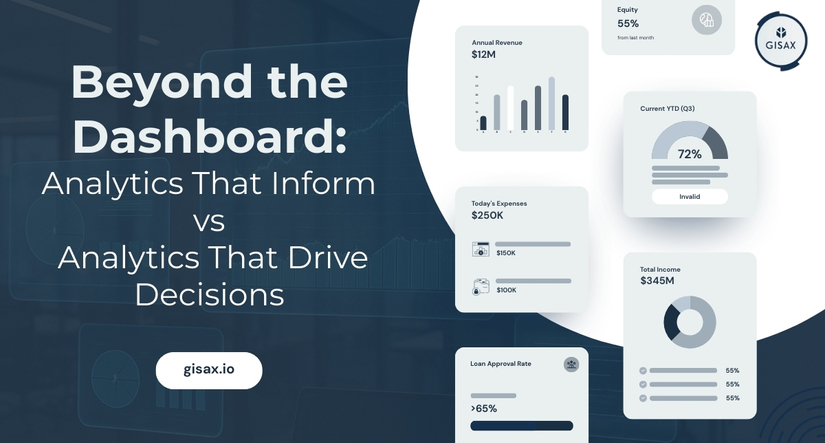
    Beyond the Dashboard: Analytics That Inform vs Analytics That Drive Decisions

    Dashboards are everywhere. Decisions are not. Most modern organizations have invested heavily in analytics dashboards. Business intelligence tools, internal reporting systems, and real-time monitoring views are now standard across teams. Dashboards are everywhere. Decisions are not. Most modern organizations have invested heavily in analytics dashboards. Business intelligence tools, internal reporting systems, and real-time monitoring views are now standard across teams. Metrics update automatically, charts refresh live, and KPIs are always visible. Yet despite this maturity, many dashboards still fail to influence decisions in a meaningful way. The issue is rarely tooling. It lies in how dashboards are designed, what data feeds them, and whether the logic behind the dashboard is built for visibility or for execution. What Actually Goes Into an Analytics Dashboard A dashboard may look simple on the surface, but technically it sits at the very end of a long data pipeline. Behind every analytics dashboard is a layered system that includes data ingestion, transformation, aggregation, and business logic. Dashboards do not generate insights on their own. They surface the output of decisions already made during system design. At a foundational level, dashboards are typically built on: data sources such as transactional databases, logs, APIs, and third-party platforms data pipelines that extract, clean, transform, and load data into analytical stores metrics and KPIs defined through business logic and calculation rules aggregation layers that convert raw data into usable signals visual components such as charts, tables, filters, and drill-downs Most dashboards are engineered to ensure accuracy and completeness, not decision speed. As a result, they are excellent at explaining what happened, but limited in shaping what happens next. Analytics That Inform: Reporting-First Dashboards Informational dashboards are designed to answer retrospective questions. From a technical standpoint, these dashboards are optimized for stability and consistency. They usually rely on batch data processing, scheduled refresh cycles, and predefined KPIs that are reviewed at fixed intervals. Because of this design, informational dashboards are best suited for: performance reviews leadership updates audits and compliance reporting historical trend analysis However, these dashboards rarely contain decision logic. The system presents the data, but the responsibility of interpretation, prioritization, and action is pushed entirely onto the user. This human dependency introduces delay and inconsistency. The dashboard informs, but it does not act. Analytics That Drive Decisions: Execution-Oriented Dashboards Decision-driven dashboards are built with a fundamentally different objective. Instead of focusing only on visualization, they encode decision intelligence into the analytics layer itself. This shifts dashboards from being passive reporting tools to active components of execution. Technically, decision-driven dashboards tend to include: thresholds and rules that define when intervention is required event-based triggers instead of only time-based refreshes prioritization logic that highlights what matters now role-specific views aligned to how different teams operate integration with workflows such as alerts, tickets, or automated actions Rather than asking users to scan dozens of metrics, these dashboards surface only what requires attention. The system reduces ambiguity before a human ever sees the data. Why Most Dashboards Stop at Visualization Most dashboards stop at visualization because the underlying analytics architecture is designed for reporting, not execution. Common technical limitations include: metrics defined without decision context dashboards disconnected from operational systems lack of real-time or event-driven pipelines no alerting or escalation logic analytics isolated from action workflows When these limitations exist, dashboards become passive by design. Teams must constantly monitor, interpret, and decide what to do next. At scale, this approach breaks down. Context Is a Data Modelling Problem Context is often treated as a UX issue. In practice, it is a data modelling and system design problem. Context is determined by: how metrics are defined which dimensions are included or excluded how data is segmented by role, geography, or time how anomalies and deviations are detected When dashboards lack context, it is usually because the data model was designed to summarize information, not to support decisions. Decision-driven dashboards require tighter coupling between data models, business logic, and operational outcomes. Real-World Case Study: How Netflix Uses Analytics to Drive Decisions A strong example of decision-driven analytics at scale can be seen at Netflix. Netflix does not treat dashboards as reporting tools alone. Analytics is deeply embedded into how decisions are made across content, product, and operations. Viewing data, engagement metrics, and experimentation results flow through systems that directly influence content investments, recommendations, and platform changes. Dashboards at Netflix are designed to answer specific decision questions: which content should be promoted or deprioritized which experiments should be scaled or rolled back where engagement signals indicate risk or opportunity Instead of reviewing static reports, teams interact with analytics that is contextual, role-specific, and tied to execution paths. This is what allows analytics to move beyond visibility and consistently shape outcomes. Designing Dashboards for Decision Velocity From a technical perspective, dashboards that drive decisions share a few common characteristics. They typically favor: fewer metrics with higher signal quality real-time or near-real-time data pipelines embedded alerts and triggers clear ownership and routing tight integration with downstream systems These systems prioritize decision velocity over data completeness. The goal is not to show everything, but to surface what matters when it matters. The GiSax Perspective At gisax.io, we see dashboards as interfaces for understanding complex systems, not just as reporting layers. The way dashboards are designed depends heavily on how data is processed, structured, and contextualized before it reaches the visual layer. This approach is reflected in the Digital Data Processing and Prediction (D2P2) system built for a data-heavy environment where digital signals were fragmented across platforms. D2P2 is a real-time social media tracing and sentiment analysis system designed to monitor digital engagement, public opinion, sentiment, and online narratives across platforms such as Facebook, Instagram, Twitter (X), YouTube, Google News, and others. By consolidating these signals, the system reduced manual monitoring, delayed insights, and reliance on static third-party reports. Experiences like this shape how we think about dashboards – not as static summaries, but as tools that surface timely signals, patterns, and context. That perspective drives how we

    Data & Systems

    Why Data, AI, and Security Can No Longer Be Treated Separately

    As systems become smarter, the consequences of weak data, AI, or security grow exponentially. For years, organizations treated data, artificial intelligence, and security as separate domains. Data teams focused on pipelines and analytics. AI teams focused on models and experimentation. Security teams operated alongside, ensuring compliance and protection. That separation no longer works. In modern systems, data fuels AI, AI amplifies decisions, and both introduce security risks that cannot be managed in isolation. When these layers evolve independently, small gaps compound into large failures. Today, the most serious incidents rarely occur because one component breaks. They happen because the connections between data, AI, and security were never designed together. Data as the Foundation of AI Systems Every AI system is only as reliable as the data it consumes. Data determines what AI learns, how it behaves, and where it fails. Poor data quality, fragmented sources, or unclear ownership do not just reduce accuracy – they introduce systemic risk that scales with automation. As AI becomes embedded into core workflows, data stops being a supporting asset and becomes critical infrastructure. Decisions about how data is collected, shared, and governed directly affect trust, risk, and outcomes. This is why organizations that treat data casually often see AI systems amplify existing weaknesses rather than create value. How AI Increases Speed and Scale of Decisions AI fundamentally changes how decisions are made. Traditional systems supported human-paced decisions. AI-driven systems operate continuously, often in real time, across massive volumes of data. Decisions are faster, broader in impact, and harder to reverse. This increased speed and scale means: errors propagate faster biased or incorrect data spreads across systems security gaps are exploited at machine speed At companies like Microsoft , this reality has driven a shift toward embedding security and governance directly into cloud and AI platforms, rather than treating them as downstream concerns. As AI accelerates decisions, safeguards must be built into the system itself. Security as a Design Requirement, Not an Add-On In modern architectures, security cannot be layered on later. Security now spans how data is collected, stored, processed, and exposed to AI models. It also includes how outputs are consumed and acted upon. This goes beyond perimeter defense. Security today includes: access control and identity data integrity and lineage model exposure and misuse prevention continuous monitoring and auditability Organizations like Apple demonstrate how privacy-first data handling shapes AI system design. By limiting data exposure and emphasizing controlled processing, Apple shows that security and data choices directly influence trust and long-term adoption. Trust, Governance, and Access Control As AI systems rely on increasingly sensitive enterprise data, trust becomes a system requirement, not a policy goal. Trust is built through: clear data ownership consistent data governance controlled access to data and models traceability across decisions and outputs Without governance, organizations struggle to explain why systems behave the way they do. Without access control, sensitive data and AI outputs become vulnerable. Over time, this erodes both internal confidence and external credibility. The Risk of Siloed System Design Many failures occur not because individual components are flawed, but because data, AI, and security were designed in silos. When teams operate independently: data pipelines evolve without security context AI models are built without full visibility into data risks security teams react after systems are already live This fragmentation creates blind spots. AI systems end up operating on data they should not access, or producing outputs that cannot be governed effectively. The GiSax Perspective At gisax.io, we see data, AI, and security as interdependent system layers rather than isolated capabilities. Decisions made at the data layer directly influence AI behavior, and both shape the overall security posture. From our experience, the highest risks emerge when these layers evolve independently. Designing them together creates clarity, accountability, and resilience as systems scale. Case Study: Equifax , When Data and Security Fail at Scale A clear example of what happens when data and security are not treated as foundational system layers is the Equifax breach. Equifax handled vast volumes of sensitive personal data, but weaknesses in security and governance led to one of the largest data breaches in history. The impact extended far beyond technical remediation. Trust erosion, regulatory scrutiny, and long-term reputational damage followed. This incident highlights a broader lesson: when data is treated as an asset but not as infrastructure, and security is treated as an afterthought, the consequences persist long after systems are repaired. Conclusion : Why This Convergence Matters As organizations increasingly rely on AI-driven systems, the cost of fragmentation grows. Treating data, AI, and security as separate concerns leads to systems that are powerful but fragile. Designing them together creates systems that are intelligent, reliable, and trustworthy. This convergence is no longer optional. It is a foundational requirement for modern digital systems. FAQs What is the relationship between data and AI? AI systems depend on data to learn, predict, and make decisions. Why is data important for artificial intelligence? Data quality directly affects AI accuracy and reliability. How does AI increase security risks? AI scales decisions, amplifying the impact of data or security flaws. Why is security important in AI systems? AI systems often process sensitive data and automate decisions. What is data governance? It defines how data is owned, accessed, and managed. How does poor data quality affect AI? It leads to biased or unreliable outputs. What is AI governance? Frameworks that ensure responsible AI behavior. Why should security be built into AI systems? Post-deployment fixes are slower and riskier. What are the risks of siloed system design? Blind spots, weak controls, and higher exposure. How does access control protect data? It restricts who can view or use sensitive information. What is data lineage? Tracking where data comes from and how it moves. How do AI models use sensitive data? To generate predictions or insights. Why is trust important in AI systems? Trust determines adoption and longevity. How does compliance relate to AI? Regulations require transparency and accountability. Why do AI systems fail in

    Data & Systems, Technical

    The Invisible Revolution: Why Wearable Tech is Moving from Gadgets to Lifestyle

    The Engineering Marvel Behind the Next Generation of Wearables   The Backstory: From Calculator Watches to the Quantified Self The idea of wearable technology is not new. Its roots go back to experimental shoe-mounted computers in the 1960s and calculator watches in the 1980s. These devices hinted at a future where technology could live on the body, but they remained novelties rather than companions. The real shift arrived in the mid-2010s with the rise of the Quantified Self movement. Wearables became mainstream tools for tracking steps, sleep cycles, heart rate, calories, and stress. Technology stopped being something we used occasionally and started becoming something we wore daily. But there was a problem. These devices still felt like technology. They demanded attention, buzzed for relevance, and constantly pulled users back into screens. We were more informed, but also more distracted. The next generation of wearables is not about adding more data. It is about removing friction. The Present: The Rise of Ambient Computing By 2026, wearable technology has entered the era of Ambient Computing. The goal is no longer to place another screen on the body. The goal is to let technology work quietly in the background. Modern wearables are powered by Multimodal AI, meaning they combine visual input, audio signals, motion tracking, and biometric data to understand context in real time. Instead of tapping, typing, or searching, users look, speak, or move naturally and the system responds. We are moving from searching for information to information finding us. This is where wearables stop feeling like gadgets and start feeling like lifestyle infrastructure.   Case Study 1: Ray-Ban Meta Glasses When AI Gets Eyes   The Ray-Ban Meta Glasses represent one of the most important shifts in AI wearables, not because of how powerful they are, but because of how normal they feel. They look like everyday glasses. The experience feels simple. You are walking through a city, look at a menu written in French, and say Hey Meta, translate this. You are hiking, see a plant, and ask Hey Meta, what kind of plant is this. No phone. No typing. No visible interaction ritual. What feels effortless is powered by a carefully orchestrated infrastructure. Under the Hood: The Three Tier Infrastructure Behind Smart Glasses   1. The On-Device “Edge” Power At the heart of the Ray-Ban Meta glasses lies the Qualcomm Snapdragon AR1 Gen 1 platform. The Processor: This is the first dedicated chip designed specifically for sleek smart glasses. It handles high-quality image processing and on-device AI without overheating the frames sitting on your face. Storage & RAM: With 32GB of internal storage, the device can handle hours of 3K video and 12MP photos locally before needing to sync. Sensors: A 5-microphone array uses beamforming technology to isolate your voice from background noise, while open-ear speakers use directional audio to keep your calls private. 2. The Smartphone Bridge The glasses aren’t a standalone computer – they use your phone as a “Co-Processor.” Through the Meta View App, the glasses offload heavy data tasks to your smartphone via Wi-Fi 6 and Bluetooth 5.3. This “hybrid processing” is what allows the battery to last through the day while still performing complex tasks. 3. The Cloud & Llama AI When you ask, “Hey Meta, look at this monument and tell me its history,” the infrastructure shifts to the cloud. The glasses capture the frame, The phone uploads it, Meta’s Llama 4 (or latest multimodal model) analyzes the pixels and the answer is beamed back to your ears in milliseconds. Latency Optimization: Meta uses “Speculative Processing” to predict what you might ask next, reducing that awkward “loading” pause Only selectively processed data flows to the cloud. Continuous raw feeds are avoided to optimize latency, bandwidth, and privacy. The Data Pipeline That Makes It All Work Every AI wearable follows a structured data pipeline: Sensors capture raw visual, audio, motion, and biometric signals On-device systems preprocess and filter the data The smartphone aggregates and enriches context Cloud AI performs reasoning and synthesis Insights return as audio, subtle visuals, or haptic feedback Latency is not an optimization. It is a core design constraint. Case Study 2: Smart Rings   The Quiet Powerhouse of Bio-Tracking If smart glasses give AI eyes, Smart Rings give it internal awareness. Devices like the Oura Ring and Samsung Galaxy Ring operate quietly in the background. They continuously track: Heart rate variability Sleep quality Body temperature Stress and recovery Long-term physiological trends The real innovation is the AI interpretation layer. Unlike glasses, rings focus on Ultra-Low-Power MCUs (Microcontroller Units). They use infrared photoplethysmography (PPG) sensors to see through your skin, tracking heart rate and oxygen without the power drain of a screen.   Instead of dashboards full of numbers, these systems provide energy scores, recovery insights, and early burnout signals. This is bio-tracking without distraction. Neural Bands: When Intent Becomes Input Beyond glasses and rings lies the next frontier of wearable technology: Neural Bands (sEMG). It reads electrical motor nerve signals at the wrist. These wearables detect: Micro muscle signals Subtle neural intent Gesture patterns with minimal movement Neural bands allow users to control digital systems through intent rather than physical interaction. No keyboard. No mouse. No screen. Wearables as a Distributed Human Nervous System Taken together, modern wearables form a system that mirrors biological intelligence. Glasses interpret the environment Rings interpret the body Neural bands translate intent Smartphones coordinate Cloud AI connects patterns over time This is distributed intelligence, not gadget overload. Invisibility, Safety, and Awareness As wearables blend into daily life, sensing becomes less visible. Just as luxury stores normalize discreet security systems, wearable infrastructure normalizes ambient sensing. The challenge is not stopping this shift. It is ensuring transparency and trust as technology disappears. As these devices like the Ray Ban Meta glasses go viral, they’ve hit a wall of social friction – specifically in security and privacy. The “Capture LED” Controversy Every pair of Ray-Ban Metas has a white LED that must shine when recording. However, we’ve

      book a visit to India