Fund Distribution Management System
Tech Stack
Client
The Haryana Rural Development Fund (HRDF) operates under the Department of Panchayats, Government of Haryana, and plays a vital role in accelerating rural development across the state.
Given the scale and financial scope of HRDF operations that cover thousands of projects across all 22 districts, efficient fund management, monitoring, and accountability are critical to its success.
By embracing (FDMS), the department is leading the way in modernizing rural governance, enabling faster decision-making, real-time progress tracking, and greater transparency in public spending.
Summary
To address the challenges of manual fund release, poor visibility, and delayed field verification, FDMS was designed as an end-to-end digital command system that transforms how public development funds are sanctioned, tracked, and audited.
At its core, FDMS acts as a centralized financial control and project intelligence hub, automating multi-level fund approvals, digitizing scheme workflows, and offering real-time dashboards for all stakeholders—from field engineers to senior officials. It seamlessly integrates geo-tagged field inspections, mobile-based site reporting, and bank-level payment automation, ensuring every rupee disbursed is tied to verified on-ground progress.
By consolidating data across state and centrally sponsored schemes, FDMS empowers the Department of Panchayats to monitor thousands of works across villages and districts—flagging delays, enforcing accountability, and enabling faster, data-backed decision-making.
In short, FDMS not only brings financial discipline and process transparency to public works—it redefines how a state government can execute high-impact rural development at scale, with confidence and control.
Challenges
Key Challenges Faced by HRDF
1. Manual, Paper-Heavy Fund Disbursement Process
- Fund release for development works required physical files to move between multiple administrative layers, causing delays and errors.
- No centralized tracking system for the status of each proposal or installment.
2. Lack of Real-Time Monitoring of Works
- Panchayat-level projects were being executed across thousands of villages, but there was no unified dashboard to track the status of works—leading to poor oversight and coordination gaps.
- Delayed identification of bottlenecks or incomplete works.
3. Delayed and Unverified Field Inspections
- Field verification by engineers (JE, SDO, XEN) was often delayed, and reports were submitted manually—sometimes without photographic evidence.
- No location validation meant site photos could be reused or manipulated, opening the door for fraudulent reporting.
4. Disjointed Scheme Management
- Different state and centrally sponsored schemes had separate reporting formats and tracking methods.
- No single source of truth to consolidate fund utilization, project count, and progress across schemes.
5. No Geo-Validation or Timestamping
- Field photos and updates lacked GPS tagging or timestamps, making audit trails unreliable.
- Cross-verification between different engineering levels (JE → SDO → XEN) was not enforced, weakening accountability.
6. Poor Data Visibility for Decision Makers
- Senior officials lacked access to consolidated reports or dashboards for:
- Works delayed by over 3 months
- Sanctioned vs. completed projects
- Fund utilization trends by district or work type
- Works delayed by over 3 months
7. Delayed Payments to Implementing Agencies
- Without an automated link to banks (HARCO), advice notes and fund release files had to be manually created and dispatched, delaying payments to executing bodies.
8. Limited Transparency and Social Auditability
- Citizens and social audit teams had no access to verified, real-time progress or spending details—hindering transparency and community trust.
Workflow
Automation for Fund Approvals
Workflow automation in fund approvals isn’t just a tech upgrade—it’s a governance innovation.
One of the most critical pain points in the HRDF’s operations was the manual, multi-layered process of fund approval, which was time-consuming, opaque, and highly dependent on physical documentation and inter-departmental coordination.
It brings speed, integrity, and structure to how public money is managed, allowing the government to do more, with greater accountability, in less time.
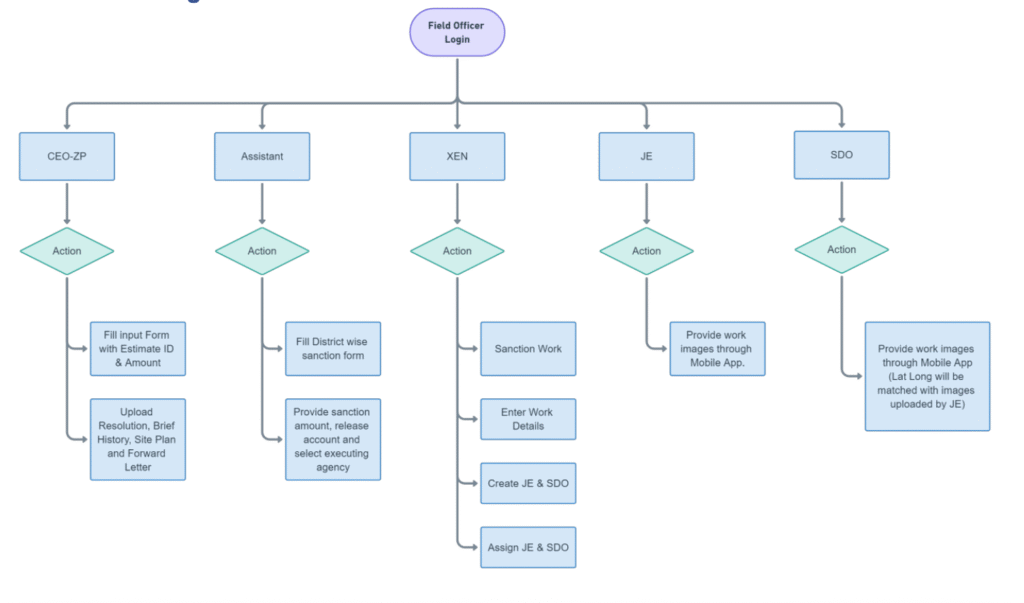
Key Enhancements Introduced:
- Role-Based Approval Matrix:
The system automatically routes fund release proposals to the correct chain of approvers based on the sanctioned amount and project type. For example:- Proposals under ₹10 lakh may require JE and SDO clearance.
- Higher-value works are routed through DM, CEO, and ultimately to ACS/CM depending on policy thresholds.
- Proposals under ₹10 lakh may require JE and SDO clearance.
- Tiered Approval Logic:
The workflow is dynamic and pre-configured to escalate to the next authority only after digital sign-off by the previous level, ensuring zero bypassing of due process. - Real-Time Tracking of Proposal Status: Each fund release request—whether for the 1st or 2nd installment—is tracked end-to-end with live updates, timestamps, and officer comments visible on a centralized dashboard.
- Elimination of Paper Files: All supporting documents (e.g., site plans, utilization certificates, sanctions) are uploaded digitally and attached to the approval chain, reducing time delays caused by couriered physical files or in-person follow-ups.
- Audit Trail & Accountability: Every approval, rejection, or escalation is logged with user IDs and timestamps—creating a transparent, tamper-proof digital audit trail to support audits and inquiries.
- Automated Dispatch to Banks: Once approved, the system generates digitally signed advice notes and triggers dispatch to banks like HARCO—automating the final step in fund release.
- Role-Based Approval Matrix:
This automation not only shortened fund release cycles from weeks to days but also brought much-needed transparency, predictability, and efficiency to rural infrastructure financing. It empowered decision-makers at every level with real-time visibility while ensuring strict adherence to financial governance protocols.
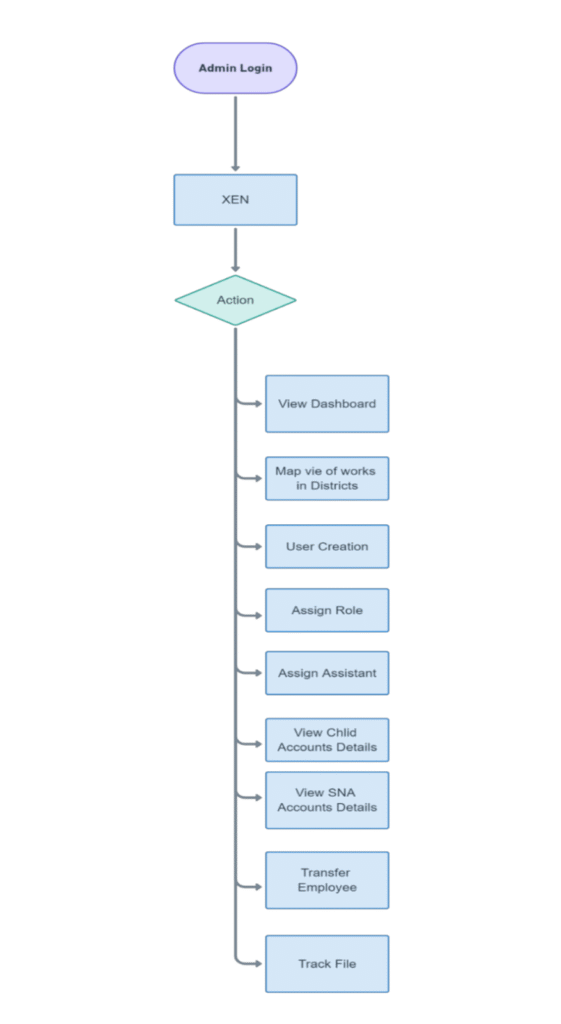
XEN:
- Sanction Work: New Sanction work are shown on screen.
- Work Details: Select District, Block, Village, sanction id, Work Id, (According to this selection Vendor Details and Work estimate Details will fetch from HEWP site)
- Select JE and SDO: In work Details form (If JE and SDO not available to this relevant District and block and village then XEN can create JE and SDO)
- Create JE and SDO
- Assign JE and SDO: Assign role
Key Benefits & Achievements
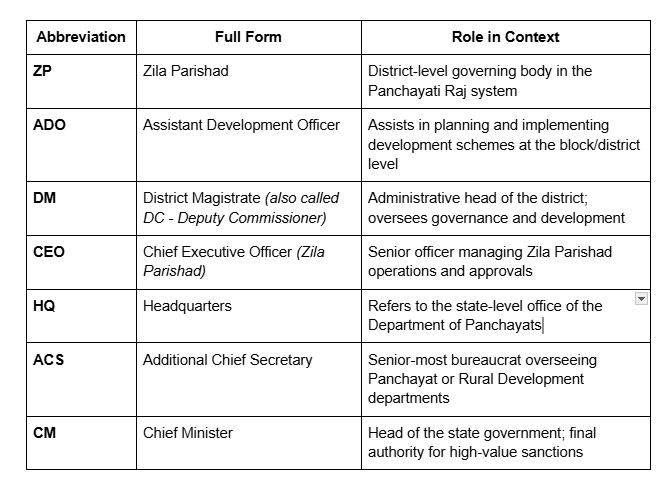
- Transitioned from manual to fully digital fund release processes, drastically reducing turnaround times.
- Enabled strategic, real-time decision-making using live dashboards and analytics.
- Empowered the government to conduct geo-tagged field verification, improving transparency and preventing misuse of funds.
- Unified multiple scheme workflows into one platform, acting as the single source of truth for development works.
- Introduced social audit capability via mobile, further enhancing accountability.
Absolutely! Here’s an improved and expanded version of the Key Benefits & Achievements section, adding more clarity, detail, and marketing value—ideal for a case study, brochure, or proposal:
Key Benefits & Achievements
1. Transitioned from Manual to Fully Digital Fund Release
The FDMS system replaced slow, paper-based workflows with a fully automated, role-based digital approval process. From project proposal to final fund disbursement, every stage is now digitized—leading to faster approvals, reduced clerical errors, and clear audit trails.
Result: Fund release cycles that once took weeks now happen in days—with improved compliance and reduced dependency on physical file movement.
2. Enabled Real-Time, Data-Driven Governance
Live dashboards give officers at all levels—Block, District, and State HQ—instant access to key project metrics like total sanctioned works, delayed projects, financial utilization, and progress by scheme or region.
Result: Decision-makers can identify bottlenecks early, reallocate resources proactively, and make informed, data-backed decisions.
3. Implemented Geo-Tagged Field Verification via Mobile
Junior Engineers (JEs), SDOs, and XENs now conduct inspections using a mobile app that captures time-stamped, GPS-verified photos and notes directly from the project site. The system cross-verifies location data to prevent manipulation.
Result: Field visits are now auditable, tamper-proof, and trust-worthy—drastically reducing the risk of false reporting and fund misuse.
4. Unified Disparate Scheme Workflows into One Platform
Previously, state and centrally sponsored schemes had separate reporting tools and formats. FDMS consolidates all scheme tracking—whether PMAY, MGNREGA, or state-funded rural works—into a unified interface.
Result: A single source of truth for thousands of projects, ensuring consistency, eliminating duplication, and enabling centralized planning.
5. Introduced Social Audit Capability via Mobile Tools
The system includes mobile-based tools that allow designated social audit teams to conduct independent evaluations and submit digital reports with supporting media.
Result: Enhanced public accountability and transparency, fostering citizen trust in how rural funds are utilized.