AI Agent Development Cost in 2026: Real Numbers and Lessons From Big Brands

By Girik Gupta, Co-Founder
Published · Last updated
What it costs to build and run an AI agent, according to five 2026 pricing guides, two big platforms, and the results Klarna, Lyft and Morgan Stanley have made public.
The short answer
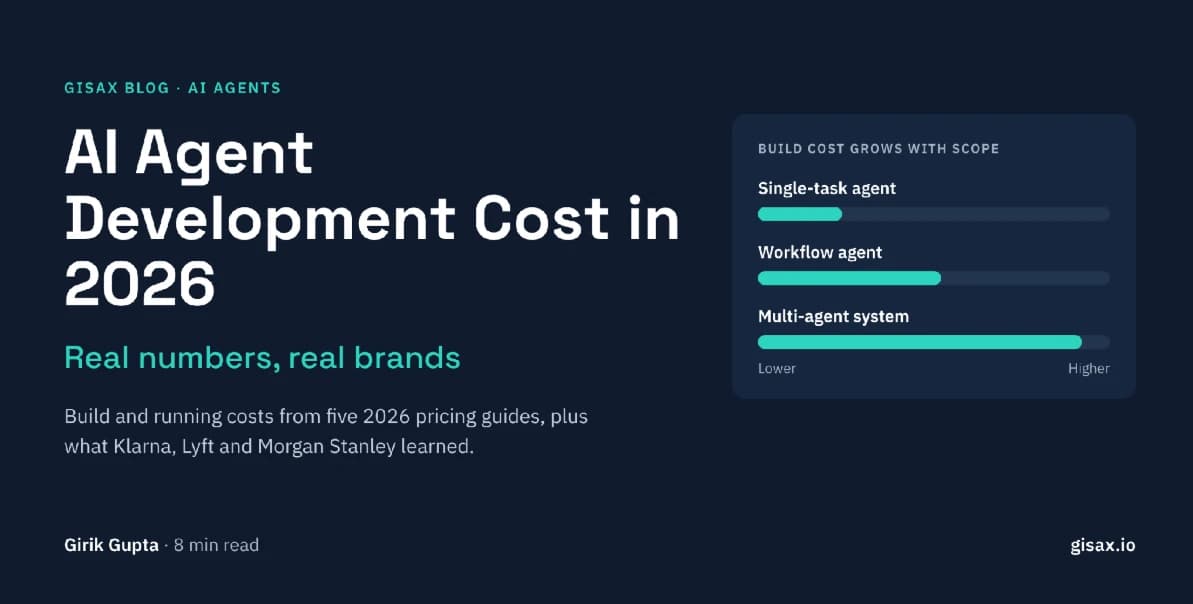
AI agent development cost in 2026 depends on how much the agent has to do. After researching in-depth and coming across five 2026 pricing guides from development firms, a simple single-task agent costs between $5,000 and $40,000 to build. Whereas, multi-agent and enterprise systems range from about $30,000 to $450,000. Running costs range from about $200 to $16,000 a month for most agents, and more at enterprise scale.
If you would rather rent than build, platforms charge per use. Salesforce Agentforce lists $2 per conversation, or about $0.10 per standard action.
The ranges are wide because each firm defines "simple" and "enterprise" differently. Here is exactly what each one publishes:
| Source | Simple / single-task agent | Multi-agent or enterprise system | Monthly running cost |
|---|---|---|---|
| RaftLabs (Dec 2025) | $15K–$40K (single-workflow agent) | $150K–$400K (multi-agent system) | $1,150–$2,600 (small) to $3,800–$16,000 (large) |
| Groovy Web (June 2026) | $12K–$22K (single-tool agent MVP) | $60K–$120K (3–5 agents); $180K–$450K (autonomous platform) | $200–$800 (MVP) to $5K–$15K (platform) |
| Cleveroad (Feb 2026) | $20K–$35K+ (reactive agent) | $100K–$200K+ (enterprise agent) | $800–$8,000+ for the AI model alone |
| SolGuruz (Sep 2026) | $5K–$10K (agent that only recommends) | $30K–$50K+ (coordinates other agents); from ~$200K (full platform) | $500–$5,000 |
| Biz4Group (Aug 2026) | $20K–$30K (simple agent) | $50K–$60K (multi-agent system) | Itemised; maintenance 15–20% of build cost a year |
These are each firm's own published estimates. Treat them as a guide, then ask for a quote based on your systems and data.
What Klarna, Lyft and Morgan Stanley show about AI agent costs
Big brands rarely publish their AI budgets. They do publish results, and the results show where the money really goes.
Klarna: big savings, then a correction
Klarna's AI assistant, built with OpenAI, handled 2.3 million conversations in its first month: two-thirds of all customer service chats and the equivalent work of 700 full-time agents. Customers resolved issues in under 2 minutes instead of 11, repeat inquiries fell 25%, and Klarna estimated a $40 million profit improvement for 2024.
By May 2025, CEO Sebastian Siemiatkowski said the company was refocusing on the "quality of human support", promising customers "there will always be a human if you want." The lesson for your budget: the human handoff and quality checks are part of the cost from day one.
Lyft: decide what "success" means before you build
Lyft's customer care assistant, built with Anthropic's Claude, has reduced average resolution time by 87% and resolves thousands of requests a day, passing customers to a human specialist when they need more help. Lyft counts an issue as resolved only when the customer answers yes to "Did we resolve your issue?" One clear metric like this decides what gets tested and improved.
Morgan Stanley: testing is a running cost, not a one-off
Morgan Stanley's AI assistant is used by over 98% of its advisor teams and can answer questions from a library of 100,000 documents. Access to those documents rose from 20% to 80%. Every use case was tested against real tasks before launch, and a daily set of test questions still checks quality and compliance. Budget for testing every month, not just at launch.
Gartner: why 40% of agentic AI projects get cancelled
Gartner predicts that over 40% of agentic AI projects will be cancelled by the end of 2027 because of escalating costs, unclear business value or weak risk controls. It also estimates that only about 130 of the thousands of vendors selling "agentic AI" offer the real thing. Agentic AI cost problems usually start with unclear scope, not with the model.
Sources: OpenAI, Lyft, Gartner.
Rent or build: AI agent pricing on platforms
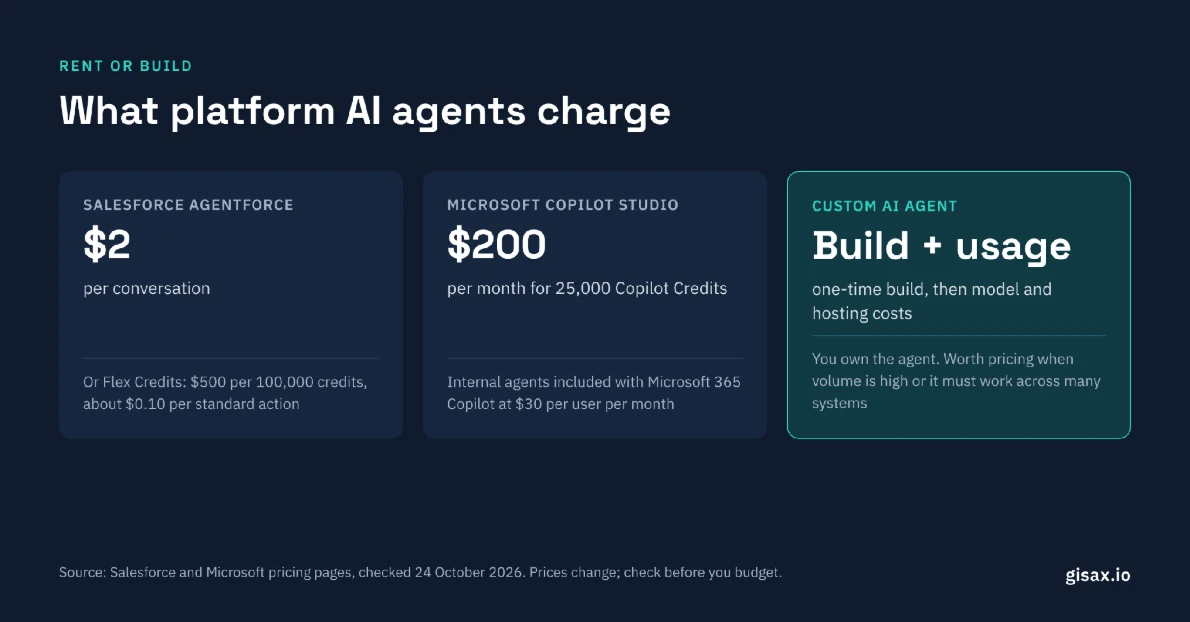
Before you price a custom build, check what the big platforms charge:
- Salesforce Agentforce: $2 per conversation, or Flex Credits at $500 per 100,000 credits. A standard action uses 20 credits, about $0.10. A per-user add-on for Sales and Service costs $125 per user per month.
- Microsoft Copilot Studio: $200 per month for 25,000 Copilot Credits, shared across your organisation. Internal agents are included with Microsoft 365 Copilot at $30 per user per month.
A platform makes sense when your team already works inside Salesforce or Microsoft 365, the agent mostly works inside that system, and volumes are moderate.
A custom agent makes sense when it must work across systems those platforms don't reach (an older ERP, your own database, WhatsApp or phone lines), you need full control of your data, or volume makes per-use pricing expensive. At 20,000 conversations a month, $2 per conversation is $40,000 a month, or $480,000 a year. At that volume, it is worth pricing a custom build.
Platform prices as listed on 24 October 2026. Prices change; check before you budget.
What drives AI agent development cost: five components
Every custom agent budget is made of the same five parts. RaftLabs' cost breakdown shows how they add up: for a single-workflow agent costing $15,000–$40,000 in total, integrations alone are $8,000–$15,000. For a customer support agent ($40,000–$85,000), integrations are $15,000–$35,000. In five of the six agent types RaftLabs prices, integrations are the largest or joint-largest line.
| Component | What it covers | What pushes the cost up |
|---|---|---|
| 1. Discovery and design | Mapping the workflow, data, risks and the number that defines success | Unclear processes, many teams involved |
| 2. Integrations | Connecting the ERP, CRM, email, phone and databases the agent uses | Older systems with no API, many systems |
| 3. Model, data and tools | The AI model, prompts, document search (RAG) and the actions it can take | Voice, many languages, messy or large data |
| 4. Testing and guardrails | Test sets, accuracy checks, human approval steps, security reviews | Regulated data, actions that move money |
| 5. Running and upkeep | Hosting, monitoring, model usage, updates and human review | High volume, uptime requirements |
Ask every vendor what each of these five lines costs.
Voice adds cost too. SolGuruz puts a voice layer at $10,000–$25,000 more than a comparable text agent, and RaftLabs prices voice AI agents at $50,000–$150,000.
How long it takes to build an AI agent
- Proof of concept: one agent, one workflow, one integration costs $30,000–$50,000 and takes 4–8 weeks, according to RaftLabs.
- Production-ready agent: 3–5 integrations, human handoff and monitoring costs $80,000–$150,000 over 12–20 weeks (RaftLabs).
- Enterprise system: $200,000+ and 16–30 weeks from contract to full production (RaftLabs).
SolGuruz puts it simply: "A working demo can take two weeks. A production-ready AI agent can take three months."
AI agent running costs after launch
The build is a one-off. These costs continue every month: model usage, which grows with volume; hosting and storage; monitoring; human review of exceptions; and updates to prompts, tests and integrations.
A real example helps. SolGuruz prices a support triage agent handling about 4,000 tickets a month at $10,200 for its first year of running costs, or about $850 a month: $4,800 for model usage, $1,800 for hosting, logging and monitoring, and $3,600 for testing and fixes.
Over a year, plan for upkeep of roughly 15–35% of the build cost. Biz4Group puts maintenance at 15–20% of development cost a year, while SolGuruz budgets 25–35% of build cost for year-one running costs, and advises adding 15–25% on top of any vendor quote before taking a budget to finance.
What makes an AI agent more expensive
- Systems with no API, where the agent has to work through screens or files
- Regulated data such as health or financial records, which adds security and compliance work
- A high accuracy bar, where a wrong answer costs real money
- Voice calls and multiple languages
- Agents that take actions, such as placing orders or moving payments, not just answering questions
- High volume, which raises model and hosting costs every month
What these agents look like in practice
Some of the agents and automation systems we have built at GiSax, with the results published on our case-study pages:
- D2P2: a social media monitoring and sentiment analysis platform that processes 500,000+ posts a week with 85% of tasks automated.
- A purchase order processor for an export house: reads, checks, routes and posts POs to the ERP, saving about 20 minutes per PO and 30+ staff hours a month on 100+ orders.
- An AI voice agent for real estate: handles 70% of inbound inquiries automatically, qualifies leads and books viewings.
Five ways to keep the cost under control
- Start with one workflow and one number. Gartner links cancelled projects to unclear business value. Pick one process and one metric.
- Design the human handoff on day one. Klarna's correction shows customers still want a person available.
- Agree how success is measured before you build. Lyft's "Did we resolve your issue?" is a good model.
- Build your test set early and keep running it. Morgan Stanley tests daily.
- Price platform vs custom at your real volume. Per-use pricing is cheap at low volume and expensive at high volume.
Red flags in an AI agent quote
- A fixed price before anyone has looked at your systems and data
- A build price with no estimate of monthly running costs
- No mention of testing, accuracy targets or monitoring
- No plan for when the agent should hand over to a person
- Unclear ownership of the code, prompts and data
AI tools can write code quickly, but production agents still need engineers who are responsible for security and reliability. We covered why in AI Writes Code. It Doesn't Secure Systems.
Planning an AI agent? Get a scoped estimate. We'll map one workflow with you, price both the build and the monthly running cost, and tell you honestly if a platform like Agentforce or Copilot Studio would be cheaper. Learn more about our AI integration services and custom software development.
Frequently asked questions
How much does it cost to build an AI agent in 2026?
Five 2026 pricing guides put a simple single-task agent at $5,000–$40,000 and multi-agent or enterprise systems at about $30,000–$450,000. In RaftLabs' cost breakdown, integrations are usually the biggest single cost line.
How much does an AI agent cost to run each month?
From about $200 a month for a small agent to $16,000 for a large customer-facing one, based on Groovy Web and RaftLabs estimates, with more at enterprise scale. SolGuruz's worked example of a support triage agent comes to about $850 a month.
Is Salesforce Agentforce or Copilot Studio cheaper than a custom AI agent?
At low volume, usually yes. Agentforce lists $2 per conversation and Copilot Studio $200 a month for 25,000 credits. At high volume, or when the agent must work across systems those platforms don't connect to, a custom build is worth pricing.
How long does it take to build an AI agent?
RaftLabs estimates 4–8 weeks for a proof of concept, 12–20 weeks for a production-ready agent and 16–30 weeks for an enterprise system.
Why do AI agent projects go over budget?
Gartner names escalating costs, unclear business value and weak risk controls as the main reasons agentic AI projects get cancelled. In practice that means vague scope, integrations that take longer than planned, and testing left until the end.
Sources
- OpenAI — Klarna customer story
- Tech.co — Klarna reverses AI customer service overhaul (May 2025)
- Lyft — Lyft and Anthropic team up (Feb 2025)
- TechCrunch — Lyft's AI customer assistant is powered by Anthropic's Claude (Feb 2025)
- OpenAI — Morgan Stanley customer story
- Gartner — Over 40% of agentic AI projects will be canceled by end of 2027 (June 2025)
- Salesforce — Agentforce pricing
- Microsoft — Copilot Studio pricing
- RaftLabs — AI agent development cost in 2026
- Groovy Web — AI agent development cost 2026
- Cleveroad — AI agent development cost guide
- SolGuruz — AI agent development cost in 2026
- Biz4Group — AI agent development cost guide (2026)